


As a marketing decision-maker, you face a familiar, recurring headache every week: “Where should I spend my outreach budget to get the highest possible return?”
You have multiple communication channels at your disposal—SMS, Email, WhatsApp, Push Notifications—each with a different cost per message. You also have a diverse customer base, spanning from brand-new leads and first-time buyers, to long-term loyalists and deep lapsers.
Every subset of users has a unique propensity to engage on a specific channel (we know this from channel response models, discussed in our earlier article on the topic). When you mix in strict weekly budget caps or volume constraints (overall and/or per channel/segment), relying on intuition or “what we did last week” inevitably leaves money on the table.
Enter our Channel Allocator tool.
What the SOLUS Channel Allocator does, and How
The Channel Allocator is a mathematical optimization engine designed specifically for CRM and growth marketers. In our earlier article, we spoke of how decision problems can be framed as optimization problems: this is an example of that principle in action.
The problem begins with a set of questions:
- How much money do you want to spend overall this week?
- Are there channel-level limits as well? Sometimes it’s a minimum, sometimes a maximum, sometimes both. This might be in terms of money or number of outreaches.
- How many people in each lifecycle segment do you want to be able to target? (Assume, to begin with, that any customer is targeted once a week – we’ll relax this later.)
- Are there channels you don’t want to use for some segments? For instance, if making a phone call is an option, you might want to do that only for the high value customer segment, whereas SMS might be better for a mass mailer.
Note that, while some of these constraints come from genuine business reasons, some might just be ones you put in for simplicity when your starting assumption is that the problem has to be solved manually.
Once these are formally put down, you have a clear definition of the problem – what we want to accomplish, as well as what guardrails we need to stay within.Under the hood, SOLUS formulates your weekly campaign as a rigorous Linear Programming problem. It evaluates predicted response scores for every customer on every channel and calculates the single, mathematically “perfect” channel allocation plan that maximizes your total expected conversions (or revenue) without breaking any of your rules.ed by solving massive optimization problems. During training, the “objective” is to minimize how wrong the model is when predicting the next word, the “decision variables” are billions of internal weights, and the algorithms iteratively adjust those weights until the error is as small as mathematically possible.)
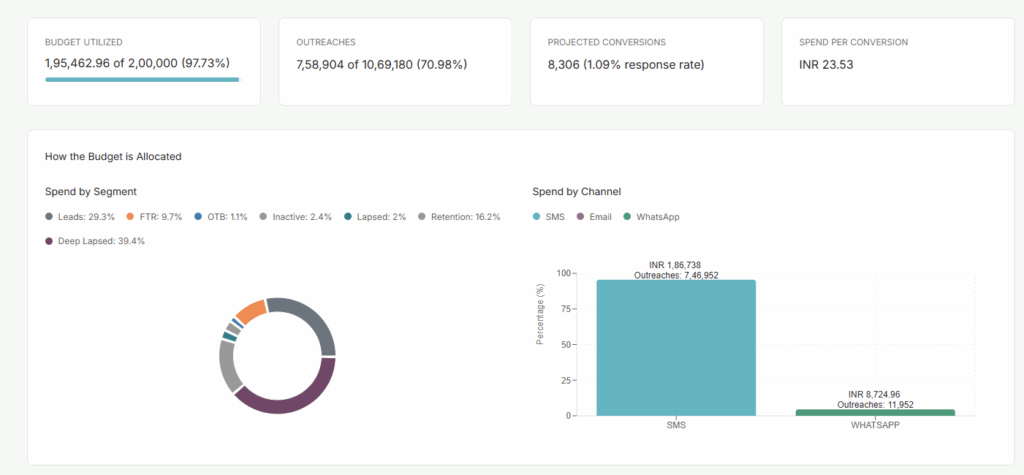
Figure 1 Here’s the breakdown of optimized spend by segment and channel separately
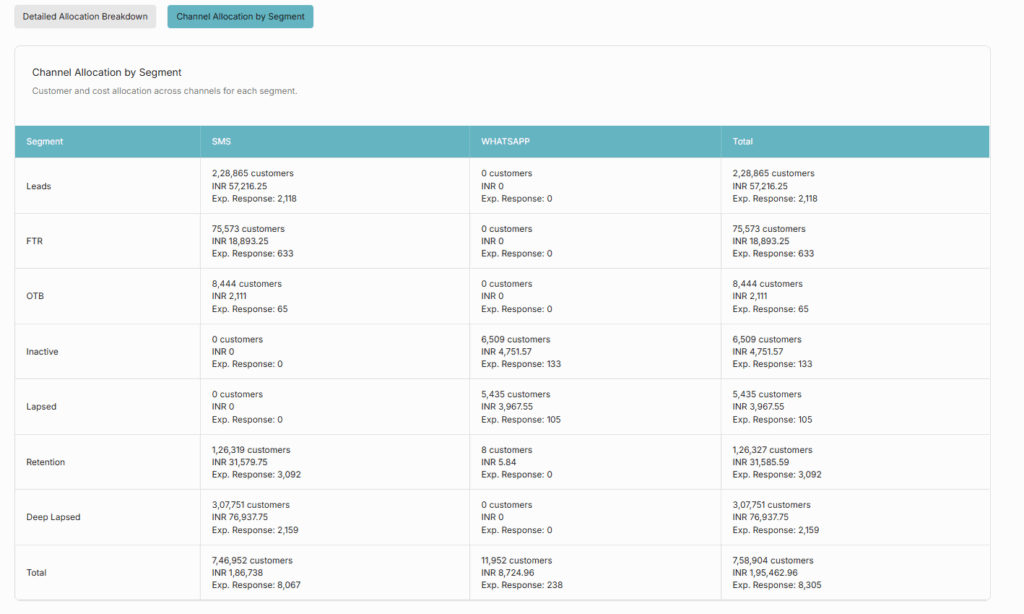
Figure 2 Here’s the allocation by channel for each segment
Beyond the Optimal Plan: “What-If” Sensitivity Analysis
One of the hardest questions to answer in a budget meeting is, “If we increased our weekly spend by 10%, how much incremental revenue would we generate?”
The Channel Allocator anticipates this. Every time it calculates your optimal weekly plan, it automatically re-runs the optimization at perturbed budget levels (80%, 90%, 110%, and 120% of your baseline).
This gives you a clear sensitivity curve. If an extra 10% budget yields a massive jump in expected returns, you immediately have the data-driven justification to ask for more budget. Conversely, if cutting the budget to 90% barely impacts your conversions (because the optimizer trims out only the least efficient outreaches), you know you can safely save those dollars.
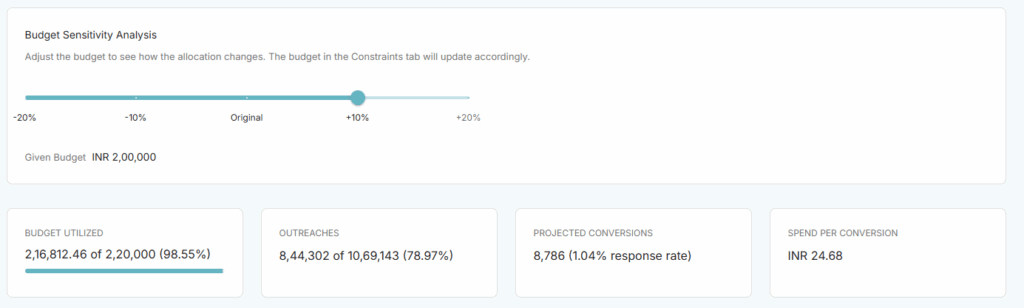
Figure 3 Here’s what the overall result looks like when we increase the budget by 10%. As you can see, we’re just spending more per conversion when we do this
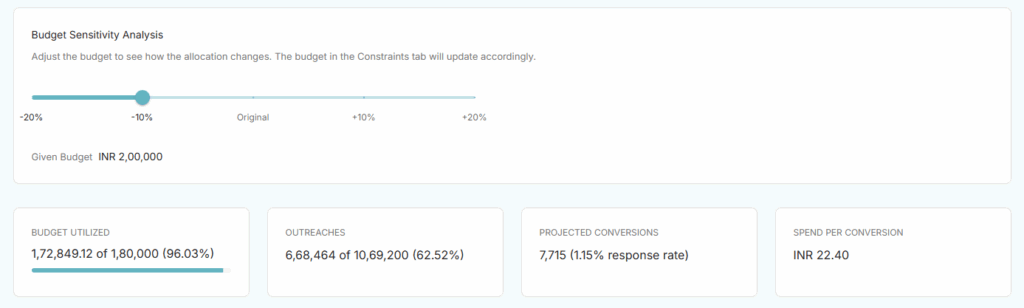
Figure 4 On the other hand, reducing the budget by 10% works out pretty okay. This is probably because the more likely responders have all been captured at a lower budget level, so the increased budget is largely focused on people less likely to respond
Understanding the “Rules of the Game”: Model Assumptions
To get the most out of any algorithmic tool, a business leader needs to understand the underlying assumptions it relies on. The Channel Allocator makes a few strategic trade-offs to keep the optimization fast, interpretable, and actionable
- The Exclusivity Rule (Single-Touch per Week)
The model assigns each customer to at most one channel per optimization period. To prevent customer fatigue and overlapping attribution, it asks: “If we can only reach this customer via one medium this week, which is the most profitable choice?” In the next version, we shall relax this assumption to allow for multi-touches per week. - Micro-Segment Homogeneity
Rather than solving an equation for 10 million individual users—which would take too long—the tool groups customers into highly granular “micro-segments” (a combination of their Lifecycle Segment and their predicted Response Score Decile for each channel). It assumes that customers within the exact same decile and segment will behave identically on average. - Linear and Additive Returns
The expected return scales linearly with the number of customers contacted in a group. It assumes that sending an email to 5,000 users in a high-propensity group yields exactly 5 times the conversions of sending it to 1,000 users in that same group. It does not natively model complex network virality. This is a reasonable assumption for most businesses, given that customers act independently of each other. - Fixed Targeting Costs
The cost per message (e.g., ₹0.1 per SMS) is assumed to be static regardless of volume. Volume discounts or fluctuating bidding prices are not natively accommodated within a single run.
A scattergun approach to lifecycle marketing is expensive. By adopting the Channel Allocator, you shift your weekly planning from operational guesswork to strategic optimization. You ensure that every rupee of your outreach budget is surgically assigned to the channel and the customer segment where it will work the hardest.